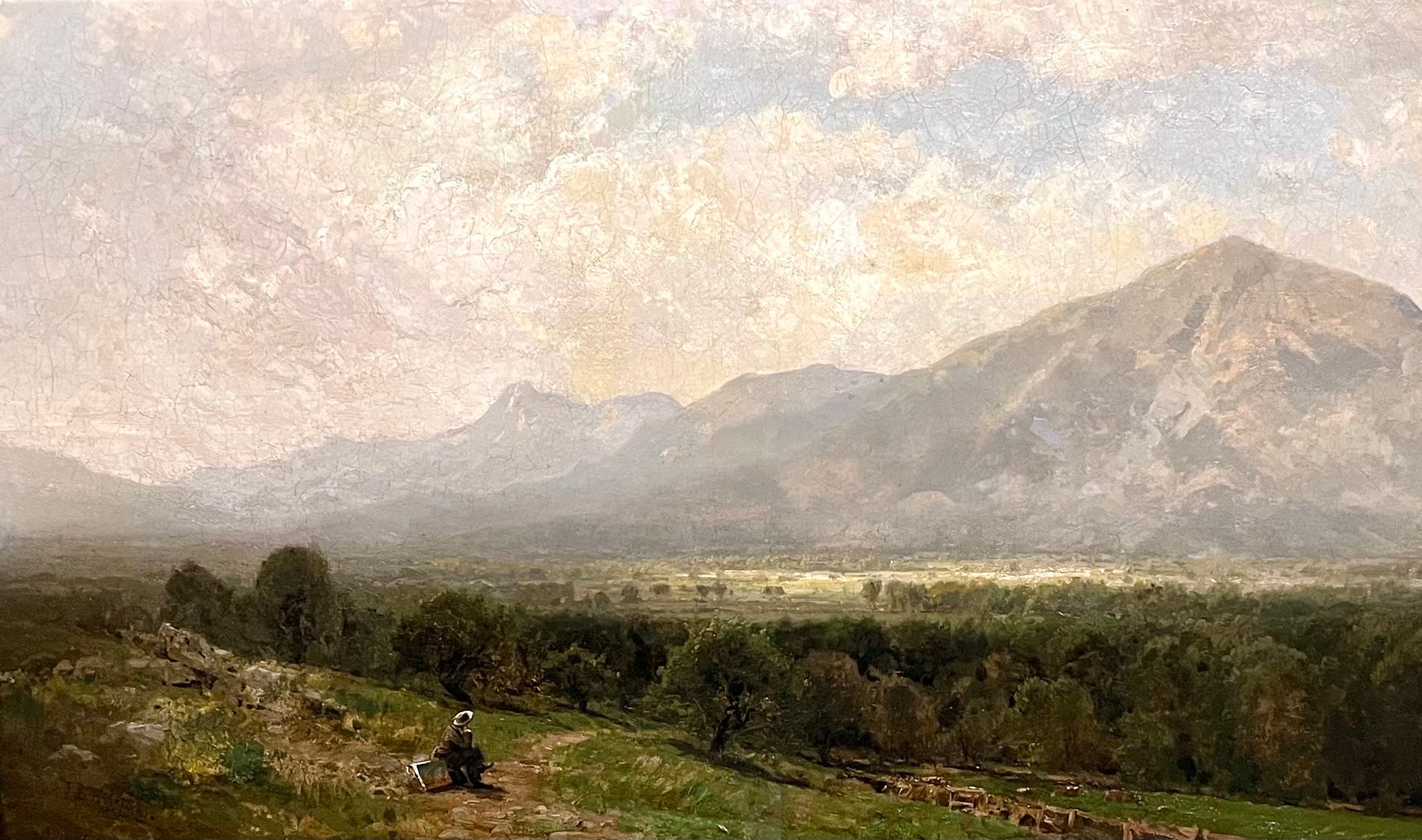
The Range. By John Bunyan Bristol, c.1860 The Hudson Valley and the Catskill Mountains
An art history question that’s been bugging me for years — admittedly a selfish, self-centered one — is why the Hudson River School painters were fixated on the Catskills to the virtual exclusion of the rest of the Hudson Valley. After all, the river — after which the school featuring heavy hitters such as Asher B. Durand, John Frederick Kensett, Sanford Gifford and the school’s founder Thomas Cole was named — doesn’t run through the Catskills.
I’ve got nothing against those mountains. They’re perfectly fine, though pretty eroded by geological time compared to the Rockies, the Tetons, the Alps and, of course, the Himalayas.
As I said, my feeling of injury is somewhat selfish. Over a lifetime of looking at paintings I’ve discovered that there are certain qualities that captivate the viewer: beauty, obviously; genius; virtuosity. But coming in a close second are scenes with which the viewer is intimately acquainted. I’ve known more than one artist who’s earned a respectable living painting the places where his patrons go: Maine, the Hamptons, the Caribbean.
Thus, it was with some interest that I visited Rolling Hills and Gracious Fields, a new show at the Columbia County Historical Society in Kinderhook, N.Y. Devoted to the county’s Hudson River School artists, their subject matters were the views outside their windows or at least within easy hiking distance.
What surprised me about the show was the high quality of the art. These weren’t amateurs; they actually knew what they were doing.
“They all had perfectly reasonable careers,” Taryn Zarrillo, the show’s curator, told me as we walked through the gallery. “They were all successful in their own right, but they weren’t Frederic Church or Thomas Cole. They are a little further down the ladder.”
My favorite painting is an 1860 work called “The Range.” It’s by John Bunyan Bristol, an artist from Hillsdale, N.Y., whose atmospheric paintings drew on his travels around New York state and New England. “The Range” comes from the Society’s collection. It depicts a painter, a canvas by his side, contemplating the bucolic Hudson Valley with the Catskills rising in the distance. It’s impossible to pinpoint exactly where he’s located, but I like to think it’s not far from my home.
The only major Hudson River School paintings that portray my neck of the woods — I’m happy to stipulate that my knowledge of the school is far from encyclopedic — do so as atmospheric smudges on the horizon, an afterthought, window dressing from some aerie high in the Catskills. This show goes some distance, no pun intended, to rectify that oversight.
Why the Hudson River Valley held less interest to 19th-century painters than the mountains isn’t hard to understand. Artists who traveled upstate from New York City were searching for unspoiled nature, for the sublime. By the early 1800s, and certainly with the arrival of the railroad, industrialism had taken root along the banks of the Hudson River. Thomas Cole was bereft by what he saw as the destruction of nature by the forces of commerce and so-called progress.
But I like to think there’s also another reason why our area was underappreciated. What draws people here these days — whether it’s full-timers, weekenders or increasingly wedding parties — is the subtlety of the landscape. There are no smoking volcanoes, no crushing cataracts such as Niagara Falls that Frederic Church famously depicted. Yet somehow, whether it’s the Hudson Valley or the Taghkanics and the Berkshires beyond, the landscape is instantly recognizable to those who love it. The rolling hills and valleys evoke reverence, if a sort that requires slightly more effort than Cole’s or Sanford Gifford’s and Asher Durand’s craggy Catskills.
I was about to glibly say “If only Cole could see it now!” regarding how nature has been despoiled in the 21st century, but that’s not the case. Several of the works in the show depict the landscape of the 1800s as virtually denuded. Where today hillsides are covered with mature trees, Hillsdale resident Cuyler Williams’ paintings — works such as 1870’s “Looking Towards Hillsdale” and 1884s “Taghkanic Mountains” — show clear-cut hillsides as far as the eye can see.
You can observe the artists in the show wrestle with industrialization and whether to include or ignore it. Henry Ary was a follower of Thomas Cole’s and an accomplished landscape painter in his own right whose work focused on Mount Merino near the city of Hudson. In one work, he might depict homesteads or the railroad intruding upon the landscape, and in the next, of virtually the identical Mount Merino scene, erase them completely.
Some of the paintings draw comparison to great European landscape painters like Claude Lorrain Poussin and Barbizon School painters such as Corot.
That’s not by accident. Despite their Hudson Valley addresses, Columbia County’s artists weren’t hicks. They weren’t influenced by Cole, Church and Kensett alone.
“You are still living in a world that is, to an extent, interconnected,” curator Zarillo said. “They are seeing pictures from elsewhere. A lot of these artists did actually travel to Europe, and that absolutely did influence the direction their work went in.”
For art lovers partial to their own landscape, and everybody else, the show continues through early January. Check out the historical society’s website CCHSNY.org for details.
Ralph’s Newsletter is a reader-supported publication. To receive new posts and support my work, consider becoming a free or paid subscriber.